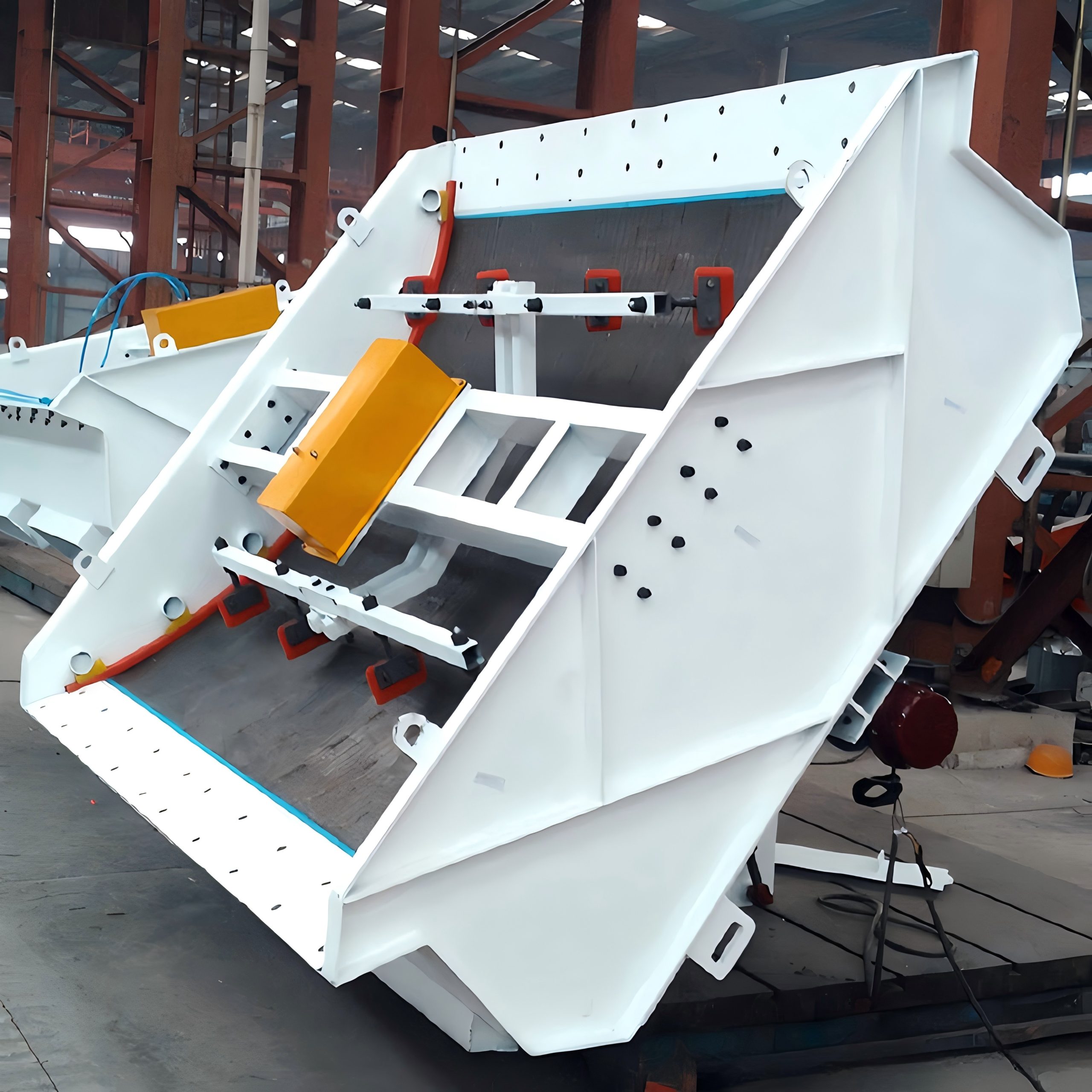
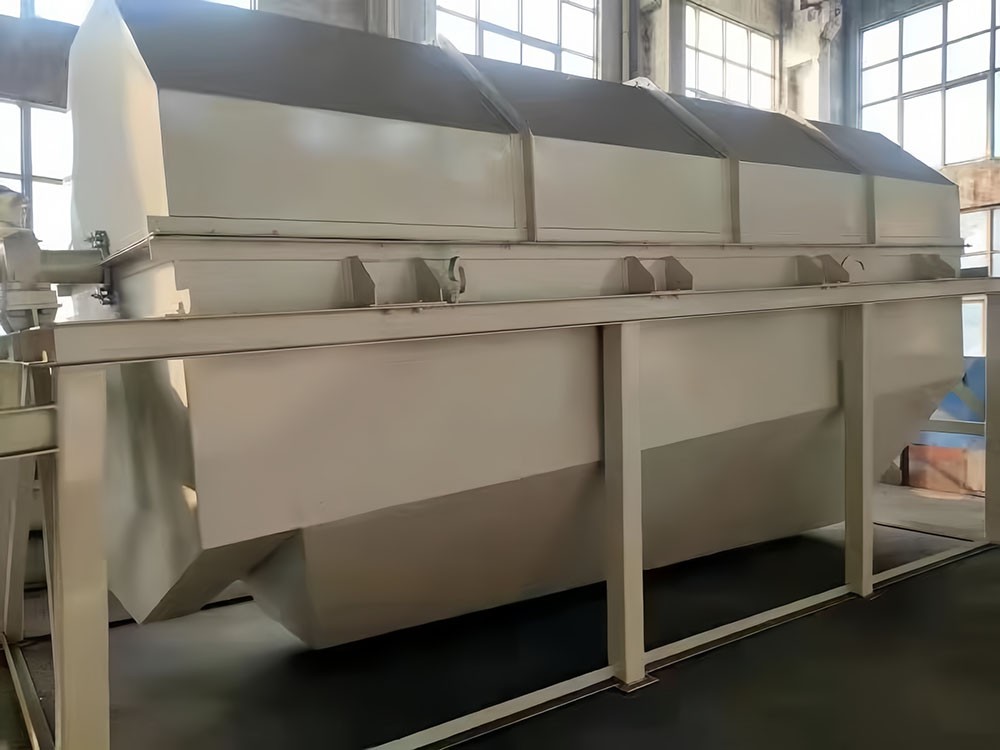
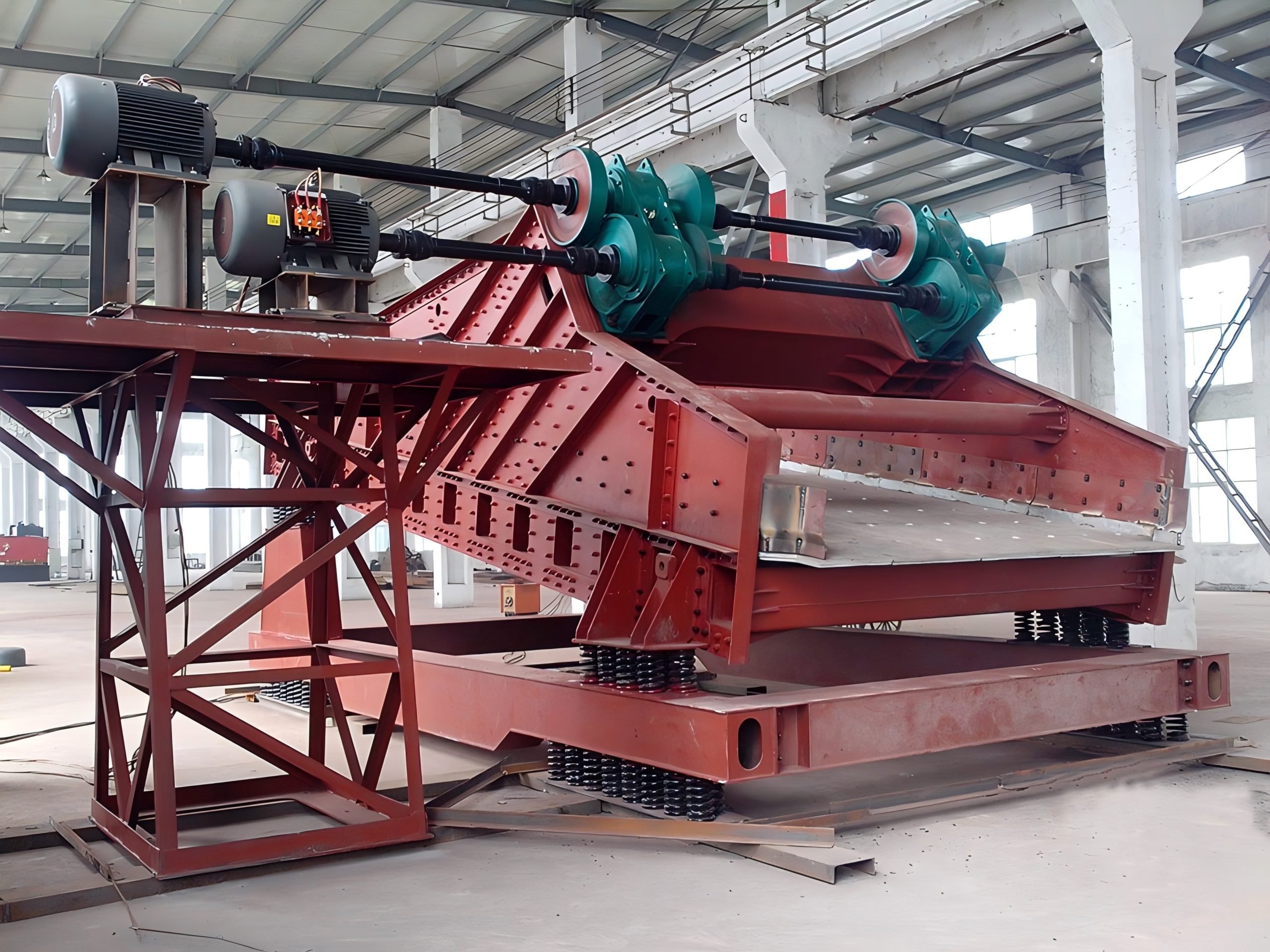
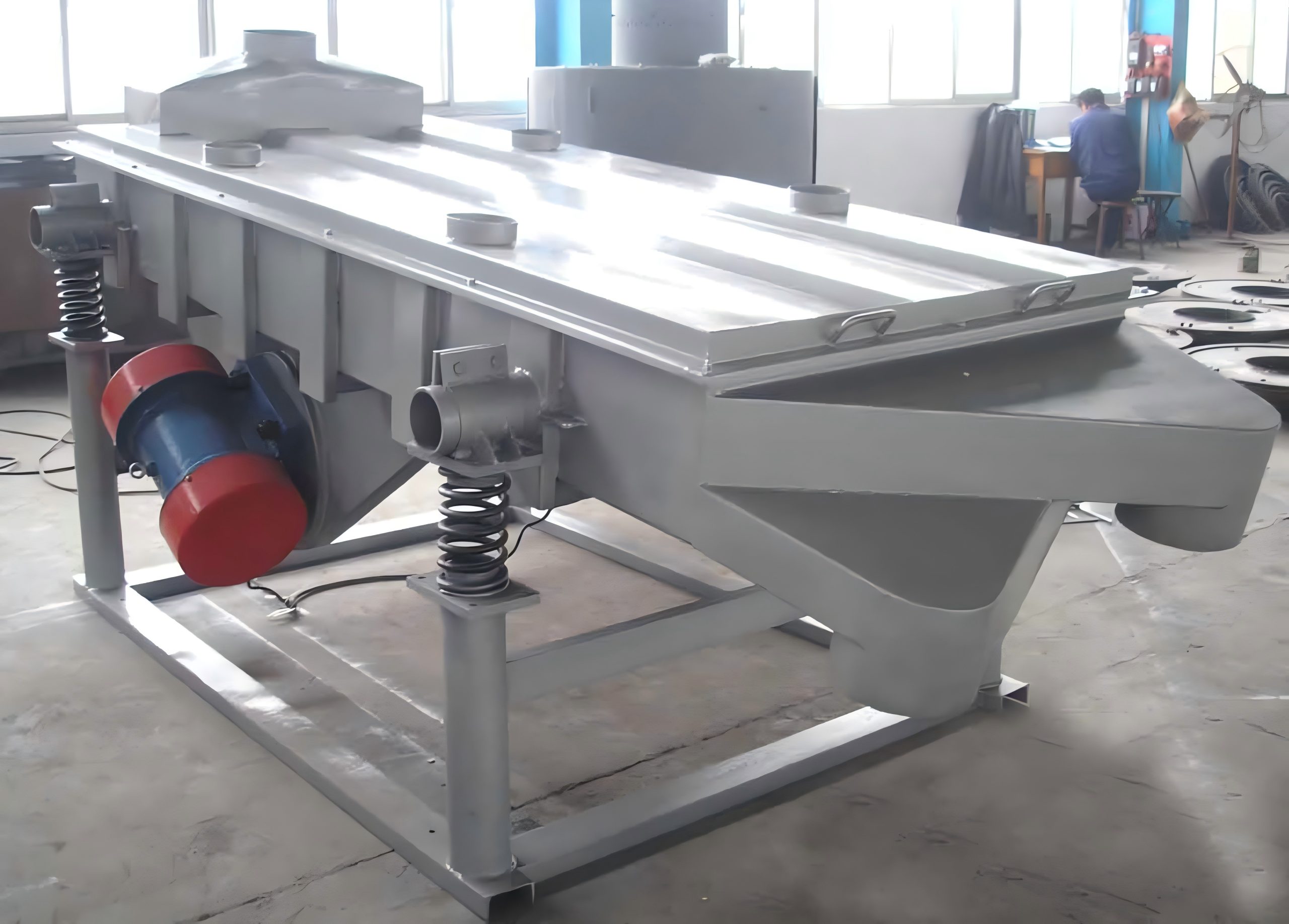
Arc screens, also known as vibrating arc screens or arc-shaped vibrating screens, are arc screens equipped with a vibrating motor (vibration source). Additionally, tiltable arc screens are available for customers to choose from. Arc screens are mainly used in coal preparation plants and mineral processing plants for pre-dewatering, desliming, and demediuming of materials, as well as for grading and recovering coal slime. They can also be used in conjunction with hydrocyclones for effective grading, dewatering, desliming, and demediuming of fine materials. This series of arc screens consists of a screen box with a wrap angle of 45 degrees or 60 degrees and a curvature radius of 20-30 mm. The arc screen surface and frame adopt a pivot-oriented structure, capable of rotating 180 degrees, extending the service life of the screen surface. The arc screen’s feed box, screen box, and screen base shaft can be tilted to achieve the interchange of the feed and discharge ends, resulting in uniform wear, extended service life, and flexible and convenient operation. It has also been widely used in the metallurgical and chemical industries.
Arc Vibrating Screen (Arc Screen) Product Overview:
The arc vibrating screen (arc screen) is mainly used in coal preparation plants and mineral processing plants for pre-dewatering, desliming, and demediuming of materials, as well as for grading and recovering coal slime. It can also be used in conjunction with hydrocyclones for effective grading, dewatering, desliming, and demediuming of fine materials. The arc screen is generally installed before the power screen to reduce the power screen’s area. It has a simple structure, small footprint, good dewatering effect, is easy to maintain, and is less prone to material clogging. The arc vibrating screen is mainly used in coal preparation plants and mineral processing plants for pre-dewatering, desliming, and demediuming of materials, as well as for grading and recovering coal slime. It can also be used in conjunction with hydrocyclones for effective grading, dewatering, desliming, and demediuming of fine materials. This screen consists of a 20-30mm screen box with a 45-degree wrap angle and a 60-degree curvature. The arc screen surface and screen frame adopt a pivot-oriented structure, capable of rotating 180 degrees, extending the service life of the screen surface.
Arc Vibrating Screen (Arc Screen) Product Working Principle and Usage Instructions:
The arc vibrating screen uses a rotating feed box, screen box, and screen base shaft to achieve the interchange of the feed and discharge ends, resulting in uniform wear, extended service life, and flexible and convenient operation. It is widely used in metallurgy, chemical industry, and other sectors.
The arc vibrating screen is a fixed slotted screen with a certain radius of curvature and wrap angle. It has no moving parts, a relatively simple structure, but a large processing capacity. In coal preparation processes, the arc screen plays a role in dewatering, desliming, desliming, and graded coal slime recovery. Depending on the feeding method, it can be divided into two types: a gravity-flow arc screen with pressureless feeding and a pressure-feed arc screen. The arc screen mainly consists of a set of horizontally arranged arc-shaped screen bars, a feeder, a discharge hopper, and a support frame. The screen bars used to make the arc screen surface are trapezoidal, and the arrangement direction of the screen bars is perpendicular to the direction of slurry movement on the screen surface. Screen bars are generally made of stainless steel, but sometimes nylon is also used.
When the slurry is fed tangentially onto the screen surface at a certain speed, under the action of centrifugal force, gravity, and friction, the slurry moves tightly against the screen surface. As the material layer flows from one screen bar to another, the edges of the screen bars cut through the material layer, separating some water and fine particles. This cut portion of material is discharged through the screen gaps under centrifugal force, becoming the undersize product; the uncut portion of material flows across the screen surface, becoming the oversize product. The thickness of the flow cut by each screen bar is generally 1/2 to 1/4 of the width of the screen gap. The largest particle in the undersize product is approximately 1/2 of the width of the screen gap.
Arc screens can be made with different radii and angles as needed. Commonly used angles are 45°, 60°, 90°, 180°, and 270°. Gravity-flowing arc screens, often employing arc angles of 45°, 60°, and 90°, are used in coal preparation and mineral processing plants. Pressure-type arc screens, frequently using arc angles of 180° and 270°, are used for grading operations in the grinding process of the cement industry.
Due to the large drainage capacity of arc screens, many coal preparation plants use them for pre-dewatering before dewatering screens. The gap between the arc screen openings is generally 3 to 6 times larger than the gap of the dewatering screen in the next process, but should not exceed 3 mm. The width of the arc screen should be 150 to 200 mm smaller than the width of the dewatering screen in the next process. Arc screens can also be used in series as needed.
Due to continuous design improvements, manufacturers have also designed arc screens with a pivot-rotating frame structure, capable of rotating 180°, thus extending the service life of the screen surface. In addition, experts have developed a bidirectional arc screen, consisting of a vibrating motor, a material distributor, and a screen box. Its key feature is that the screen box comprises two side plates, a support steel pipe, two counter-mounted screens, and a distribution plate. The screens are fixed to one end of the support steel pipe by pressure strips and wooden wedges, while the other end of the support steel pipe is fixed to a base. The side plates are connected to the base. The vibrating motor is installed outside the screen box, and the material distributor is installed on top of the screen box. This bidirectional arc screen uses two screens, which not only increases the throughput of the arc screen but also improves the screening efficiency by using a vibrating motor, and makes screen replacement very convenient.
Arc-shaped Vibrating Screen (Arc Screen) Model Description:
HXS □ □
┬ ┬ ┬ ┬
│ │ │ │
│ │ │ └────────── Number of Screen Layers
│ │ │
│ │ └───────────- Screen Length (mm)
│ │
│ └───────────── Screen Width (mm)
│
└──────────────- Arc-shaped Vibrating Screen
Arc-shaped Vibrating Screen (Arc Screen) Sharp Upper Edge:
For an arc-shaped screen to function well, it is crucial that the rollers forming the screen plate have a sharp upper edge in contact with the fluid. If the water contains abrasive substances, the upper edge of the screen rollers will gradually become rounded, while the lower edge will become sharp.
In this situation, periodically inverting the screen plate helps extend its lifespan and restore screening efficiency. Fibers in the suspension are always arranged in an orderly fashion along the flow direction. This means that most fibers longer than the screen openings will be trapped on the screen surface and slide down to the discharge port, resulting in a solids concentration of 3-4%, depending on the application.
Under normal operating conditions, the screen plate causes continuous fluid turbulence. If clogging is likely under abnormal conditions, it can be easily cleaned with water pipes even during operation. In extremely difficult applications, a swing-type cleaning device can be installed to automatically clean the entire screening surface at regular intervals. The water consumption for cleaning arc screens and arc vibrating screens is 120 LPM (32 GPM) per screen plate, requiring a water pressure of 70 Bar (100 psi).
Applications of Arc Vibrating Screens (Arc Screens):
Wastewater from wood processing workshops, peeling wastewater, wood chip washing water, slag dewatering, and fiber separation.
Grading and Concentration of Arc Vibrating Screens (Arc Screens):
An arc screen is a simple and efficient device capable of recovering fibers and other particles as short as 350 microns in length from aqueous suspensions. Arc screens have a compact structure with no moving parts and require minimal maintenance.
The unique screen plate is composed of an arc-shaped surface formed by wedge-shaped bars with horizontal gaps between them, typically 350 microns wide. The liquid to be screened enters through a feed box and flows by gravity through a weir to the screen plate. As the suspension flows along the screen plate, a thin layer of water is cut off by the screen bars and passes through the screen gaps along with the fine particles.
Working Principle of Arc Vibrating Screens (Arc Screens):
The dewatering principle of arc vibrating screens relies on the cutting action of the sharp edges of the screen bars on the feed side to separate the coal slurry water. Depending on the application and the moisture content of the material, arc screens are further divided into vibrating arc screens and non-powered arc screens. The HS arc screen features a rotating feed box, screen box, and screen base shaft, allowing for the reversal of the feed and discharge ends. This results in uniform wear, extended service life, and flexible and convenient operation. It is widely used in industries such as metallurgy and chemicals.
Arc Vibrating Screen (Arc Screen) Product Dimensions:
| 型号 |
外型尺寸(mm) |
| A |
A1 |
B |
B1 |
H |
H1 |
| HXS0715Ⅰ |
489 |
384 |
700 |
855 |
2760 |
0 |
| HXS1015Ⅰ |
489 |
38 |
1000 |
1155 |
2760 |
0 |
| HXS1315Ⅰ |
489 |
384 |
1300 |
1455 |
2760 |
0 |
| HXS1615Ⅰ |
489 |
384 |
1600 |
1755 |
2760 |
0 |
| HXS1915Ⅰ |
489 |
384 |
1900 |
2055 |
2760 |
0 |
| HXS2215Ⅰ |
489 |
384 |
2200 |
2355 |
2760 |
0 |
| HXS0720Ⅰ |
666 |
492 |
700 |
855 |
2905 |
173 |
| HXS1020Ⅰ |
666 |
492 |
100 |
1155 |
2905 |
173 |
| HXS1320Ⅰ |
666 |
492 |
1300 |
1455 |
2905 |
173 |
| HXS1620Ⅰ |
666 |
492 |
1600 |
1755 |
2905 |
173 |
| HXS1920Ⅰ |
666 |
492 |
1900 |
2055 |
2905 |
173 |
| HXS2220Ⅰ |
666 |
492 |
2000 |
2355 |
2905 |
173 |
| HXS2420Ⅰ |
666 |
492 |
2200 |
2555 |
2905 |
173 |
Основные технические параметры дугового вибрационного грохота (arc screen):
| 型号 |
处理量 t/h |
筛宽(mm) |
弧形半径R(mm) |
包角 (度) |
筛孔尺寸(mm) |
| HXS0715Ⅰ |
40-80 |
700 |
2030
|
45 |
0.3~1.0 |
| HXS1015Ⅰ |
60-120 |
1000 |
45 |
| HXS1315Ⅰ |
90-180 |
1300 |
45 |
| HXS1615Ⅰ |
120-220 |
1600 |
45 |
| HXS1915Ⅰ |
160-300 |
1900 |
45 |
| HXS2215Ⅰ |
200-360 |
2200 |
45 |
| HXS0720Ⅰ |
40-80 |
700 |
60 |
| HXS1020Ⅰ |
60-120 |
1000 |
60 |
| HXS1320Ⅰ |
90-180 |
1300 |
60 |
| HXS1620Ⅰ |
120-120 |
1600 |
60 |
| HXS1920Ⅰ |
160-300 |
1900 |
60 |
| HXS2220Ⅰ |
200-36 |
2200 |
60 |
| HXS2420Ⅰ |
220-400 |
2400 |
60 |
Инструкции по оформлению заказа:
1. При оформлении заказа, пожалуйста, укажите, включает ли угол заворачивания и радиус кривизны загрузочный бункер.
2. Мы можем спроектировать и изготовить дуговые грохоты с различными углами заворачивания и радиусами кривизны в соответствии с требованиями пользователя.